


Humic Acid Powder/Granules
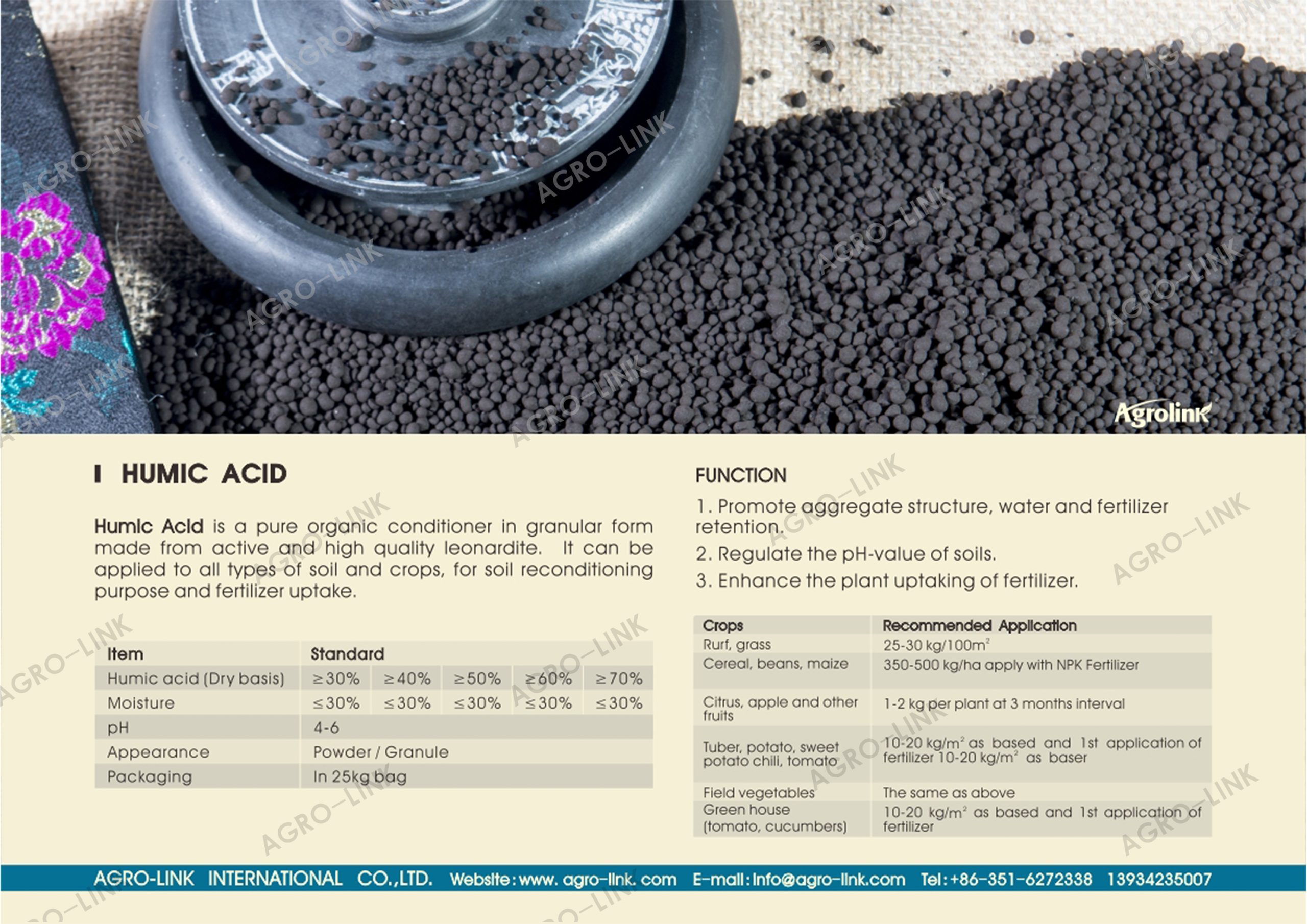
Mineral humic acid is available in powder and extrusion granule forms. Fine powder suits fertilizer blending. Extruded granules have low dust, fit mechanical spreading and field basal application. Extracted from leonardite with controllable parameters, supplied as raw material for soil amendment.
HA(Dry basis)
Organic Matter
Moisture
pH(1% solution)
Size
≥30%/≥40%/≥50%/≥60%/≥70%
60%-90%
≤30%
4-6
60-80 Mesh
2-4 mm
Description
Humic acid is a natural macromolecular organic mixture derived from leonardite and lignite, containing abundant carboxyl and phenolic hydroxyl functional groups.
Humic Acid Powder Dark brown fine powder, typically 80–100 mesh, loose texture. It is produced by crushing, grinding and screening mineral raw materials. It can dissolve in alkaline systems and is convenient for formulation. With large specific surface area, the powder disperses evenly during blending, suitable for fertilizer compounding and raw material premixing.
Humic Acid Granules Dark brown hard spherical granules with common particle size 2–4 mm. Manufactured by extrusion granulation, drying and screening from humic acid powder. Low dust, good flowability and anti-caking property, easy for bulk transportation and mechanical spreading. Once incorporated into soil matrix, organic components are released gradually. Widely used for basal application and compound fertilizer blending.
Both forms feature consistent physical and chemical parameters with batch laboratory inspection. They serve as raw materials for soil amendment in agriculture and horticulture. Customized humic acid content, particle size and packaging are available with stable bulk supply.
Specification

Application

** For reference only. Application Rate vary by crop, growth stage, and region.
Function
Humic acid contains abundant active functional groups including carboxyl and phenolic hydroxyl groups, presenting ion exchange and complexing properties. Within soil systems, it participates in the formation of soil colloids, assists the construction of soil aggregates, modifies soil pore structure and influences physical properties of soil such as water retention and air permeability.
Humic acid powder features a larger specific surface area for sufficient contact with soil components. Humic acid granules disperse gradually under ambient conditions; their components take part in ion exchange between soil solid and liquid phases step by step and exert impacts on soil buffering system. Both can act as organic components to supplement soil organic matter pool.
This organic fraction can adsorb partial metal ions in the system and reduce the free ion concentration in liquid phase. Meanwhile, it supplements the soil organic matter pool, affects the charge characteristics of soil colloids and alters the interaction state between soil particles. The powder form facilitates uniform dispersion in blending systems, while granular form enables a slower and sustained participation of active components.
Customizable Packaging
20/25/1000 kg — Laminated Kraft paper bags, Color-printed bags, or FIBCs
Do you want to find a reliable supplier?
Choose Agrolink.