


Bio Fulvic Acid
Biochemical fulvic acid is mainly produced from biomass such as crop straw and bagasse through microbial fermentation. Under controlled temperature and humidity, specific microorganisms break down plant organic matter into small-molecule organic acids, from which the fulvic acid fraction is obtained. After concentration, drying, and grinding, it becomes powdered biochemical fulvic acid. It differs from mineral-source fulvic acid, which is extracted from coal.
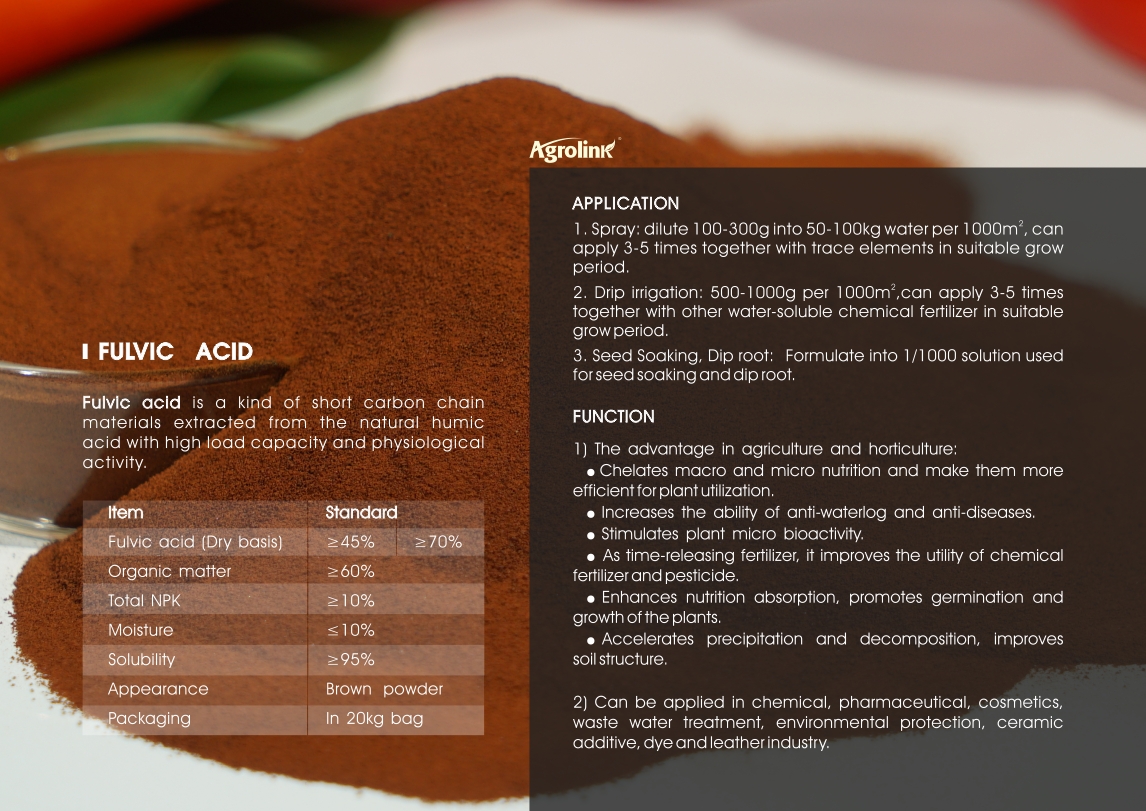
Fulvic Acid(Dry basis)
Organic matter
Total NPK
Water solubility
Moisture
Packaging
≥45%/≥70%
≥60%
≥10%
≥95%
≤10%
10/20 kg — PP woven bags, or Color-printed bags
Description
Biochemical fulvic acid is derived from modern plant organic matter through microbial fermentation and decomposition. It shows excellent water solubility, dissolves rapidly in cold water, and forms a clear solution with low precipitation tendency, making it suitable for drip irrigation and foliar spray systems. With a smaller overall molecular weight and evenly distributed active functional groups, it offers better compatibility during chelation with metal ions and blending, and generally compatible with medium and trace elements and amino acid materials under normal application concentrations and recommended ratios.
Specification

Application
- Spray: dilute 100-300g into 50-100kg water per 1000m2, can apply 3-5 times together with trace elements in suitable grow period.
- Drip irrigation: 500-1000g per 1000m2,can apply 3-5 times together with other water-soluble chemical fertilizer in suitable grow period.
- Seed Soaking, Dip root: Formulate into 1/1000 solution used for seed soaking and dip root.
** For reference only. Application Rate vary by crop, growth stage, and region.
Function
1. Rich in Organic Components with a Scientifically Balanced Nutrient Profile.
Biochemical fulvic acid is not a single-molecule compound. In addition to its high fulvic acid content, it is rich in various nutrients required for plant growth, including nitrogen, phosphorus, potassium, amino acids, enzymes, sugars, and proteins.
2. Strong Complexation Capacity.
Biochemical fulvic acid has a high total amino acid content and is rich in active functional groups such as carboxyl and hydroxyl groups, as well as oxygen-containing functional groups. Its structure contains numerous organic chelation and complexation sites. These ligand groups can undergo complexation or chelation reactions with sparingly soluble trace elements such as calcium, magnesium, sulfur, iron, molybdenum, zinc, manganese, copper, and boron. They can also undergo complexation reactions with phosphorus at other sites. Through these reactions, the biochemical fulvic acid molecule acts as an intermediary carrier, coordinating and promoting the uptake of trace elements and phosphorus by plant roots or leaves.
Customizable Packaging
10/20 kg — PP woven bags, or Color-printed bags
Do you want to find a reliable supplier?
Choose Agrolink.