/ Page / Sodium humate
sodium humate1 logo sodium humate powder logo sodium humate crystal2 logo sodium humate flakes1 logo sodium humate 柱状logo sodium humate 3 logo sodium humate crystal1 logo sodium humate big flakes logo 60YF腐钠溶解过程图 IMG_0732 IMG_0717

Sodium Humate

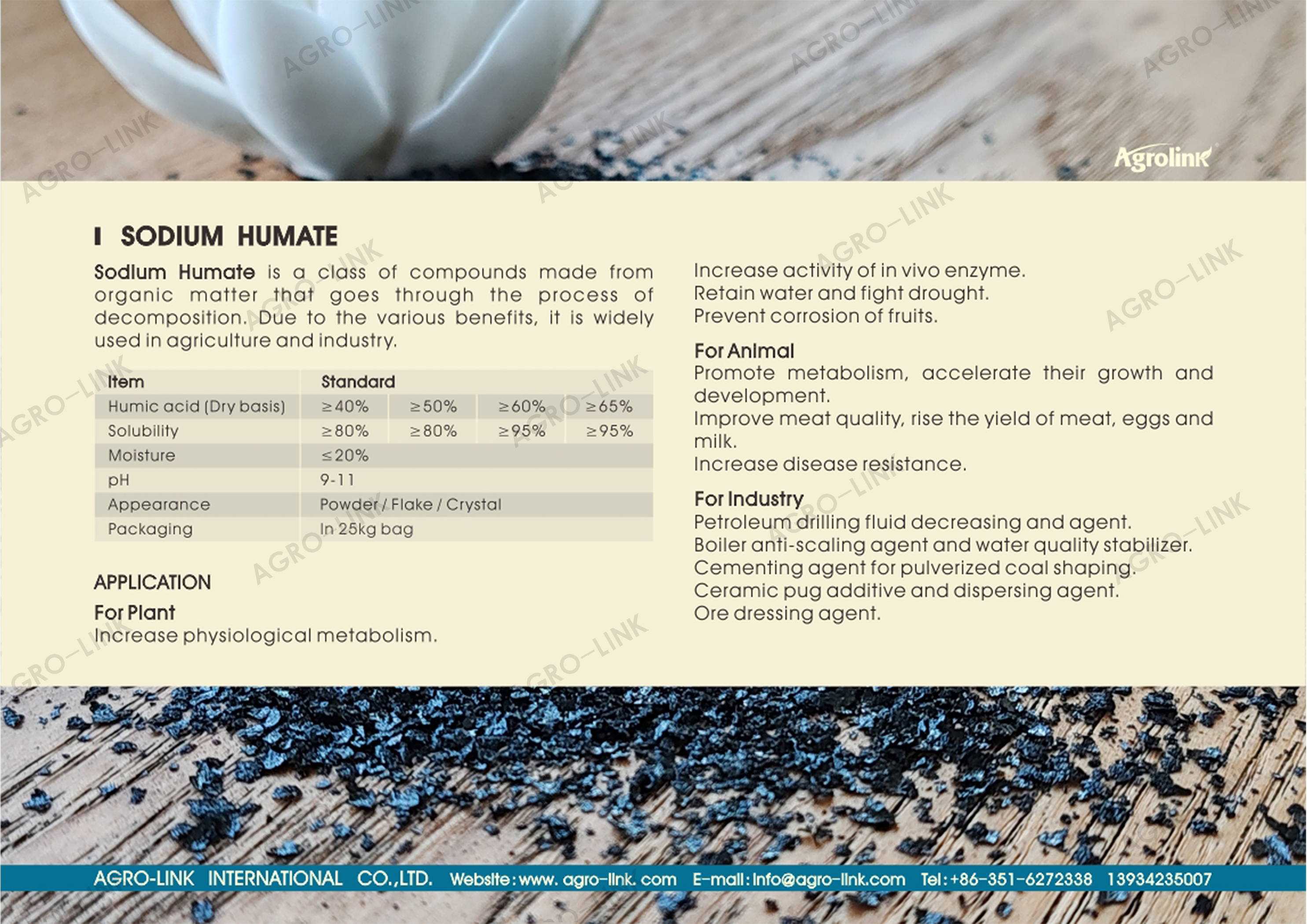
As a member of the humic acid family, sodium humate can be applied in many fields such as agriculture, aquaculture and feed industry, which is closely related to its various active functional groups including carboxyl, phenolic hydroxyl and quinone groups.

HA(Dry basis)

Moisture

Application

Size

≥40%/≥50%/≥60%/≥65%

≤20%/≤15%/≤12%

Agriculture/Aquaculture/Feed/Industry

1-2/2-4mm Flakes&Crystal

3-5mm Flakes

60-80/80-100 Mesh

Description

Sodium Humate is an organic salt obtained by alkalization of humic acid from mineral sources such as weathered coal and lignite. Its molecular structure contains carboxyl groups, phenolic hydroxyl groups and other active functional groups. It features colloidal properties and good water solubility, compatible with many substances, widely used as raw material in agriculture, industry, animal husbandry and aquaculture.

  1. For plants
    Sodium humate can be used as a soil conditioner and raw material for plant-related applications.
  2. For animals
    Sodium humate can be used as feed-related raw material, and for the improvement of water body and sediment.
  3. For industry
    Water purification, drilling mud treatment, boiler antiscaling, water quality stabilization, particle binding, raw material for battery cathode plates, ceramic additive, cement water reducer, pigment auxiliary, metal ore flotation agent.
  1. Agricultural use: for soil conditioning and nutrient activation.
    Within soil systems, sodium humate participates in soil microenvironment changes:
    Physical aspect: participates in the formation of soil aggregate structure and affects water permeability and air porosity of compacted soil.
    Chemical aspect: through chelation, it binds with immobilized trace elements in soil and alters their existing forms.
    Biological aspect: it supplies carbon sources for soil microorganisms and interacts with root cells.
  2. Feed use: applied for intestinal adsorption.
    When entering animal intestinal tracts, its active functional groups exhibit adsorption properties:
    Adsorption: capable of binding metabolites such as ammonia, hydrogen sulfide and biogenic amines in intestines.
    Ion exchange: interacts with protein substances in feed via ion exchange and adsorption.
    Microbiome: interacts with various microorganisms in the intestinal tract.
  3. Aquaculture use: for water body conditioning.
    In aquaculture water, sodium humate acts on the water environment:
    Water adsorption: adsorbs heavy metal ions, ammonia nitrogen and organic pollutants in water and participates in pH stabilization.
    Light shading: dark powder changes light transmittance of water, interacts with algae and supplies carbon sources for certain algae.
    Material property: as a feed auxiliary, it contains active substances including SOD and alkaline phosphatase.

20/25/1000 kg — Laminated Kraft paper bags, Color-printed bags, or FIBCs

Inquire Bulk Pricing Now